


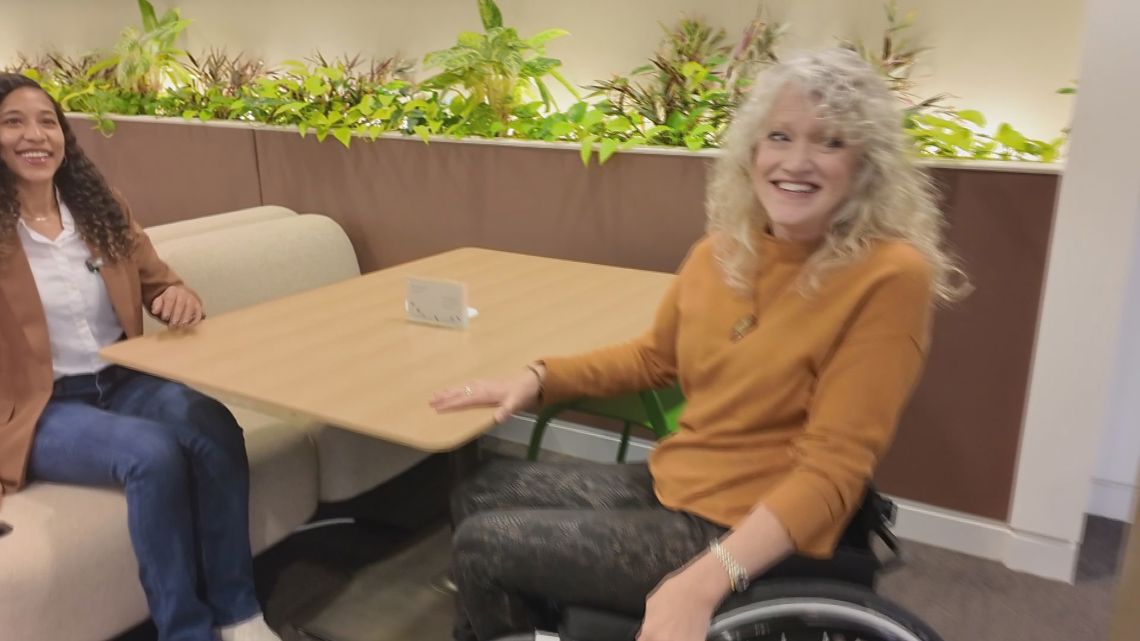
Steelcase collaborates with Disability Advocates of Kent County to ensure its office furniture is accessible to all, creating inclusive spaces.
GRAND RAPIDS, Mich. — Steelcase has been making office furniture for more than 100 years and they recently started a new initiative to make sure that furniture can be used by any and everyone.
“When we build spaces without having an accessibility lens on it, what we’re saying is, ‘we don’t want you here.’”
Those are words from Nicholette Driggs with Absolutely Accessible Kent, a program through the Disability Advocates of Kent County (DAKC).
Steelcase doesn’t want their office furniture turning anyone away. So, they turned to the DAKC.
Driggs said, “Our test pilots are a group of individuals with a variety of disabilities, variety of ages, ethnicities, life experiences who come together and we are able to go through spaces and give that real-world, real-life experience of someone who faces these barriers on an everyday basis.”
Taylor Derusha is one test pilot. She’s legally blind.
She said, “I have some tunnel vision in the right eye that’s remaining, but that’s it.”
Vicky Schmidt is another test pilot.
“My family was in a car accident. There was a road defect and so, we ended flipping forward three times in the vehicle,” she said before explaining she’s had “a disability now for 24 years. I’m a high-level paraplegic.”
Kamara Sudberry is a global inclusive design leader with Steelcase. She told 13 ON YOUR SIDE the company is asking, “how do we include everyone? How do we consider their needs proactively?”
“Every barrier that you have is one less person you serve,” said Driggs. “There are so many ways that you can start addressing barriers and accessibility challenges that don’t cost a lot of money. So, whether it’s switching your knob door to a lever door handle, checking to make sure your doors aren’t too heavy.”
The company kicked off their Accessibility Tours just last year.
“Bringing folks in early to get some insight on how we can be building our products differently. Making sure that everyone has a seat at the table,” said Sudberry.
She also pointed out, “We have these beautiful, really lightweight chairs.”
A chair that can be easily moved out of the way, making room for someone in a wheelchair.
Schmidt said, “Just makes you feel included, and you don’t feel ‘othered,’ like ‘all you others go here.’ Things like that are very demeaning and it just feels disrespectful.”
Steelcase also taking things a step further, making tables and desks adjustable too.
Schmidt demonstrated for our cameras, saying, “Being able to move the desk up and down because I am able to stand for short times and I love just the ability to be able to do that.”
The furniture company even using what may look like simple décor as a helpful guide.
“It’s really hard to determine where you are in the room. So, if I know exactly where this is in the middle of the room, it’s easier to tell where I am,” said Derusha as she showed us how the decoration helps. “Almost like a landmark, because if it’s just a big empty room that you’re trying to navigate, it’s like shooting in the dark.”
Steelcase considers many different options for many different people. Options many never even think about. Like special sensory areas.
“These are our pods, our phone booths. A really cool feature is that these have now been certified as autism support resources for folks who need a quiet area, a space to step away and for a quick phone call,” said Sudberry.
There are also adjustable cubicles.
Sudberry said, “All of our boundaries are made with magnets. They’re also lightweight,” as she easily made changes to the layout of one cubicle.
It’s also about making sure those who use wheelchairs have a smooth ride.
“They call them threshold strips. To me, I call them speedbumps or I’m going to do a faceplant,” said Schmidt.
She showed us by rolling around in her wheelchair how helpful it is when there’s no disruption to the surface. “This being a different surface – I just love this. There’s nothing.”
Steelcase also relies on the test pilots to point out areas that could still use improvement.
“For me, I love to get out of my chair, but this is too low. So, this would be a really difficult transfer for me because I would have to lift from here up to my chair height,” said Schmidt.
Sudberry said, “I think it’s just another opportunity for us to continue to innovate, create new solutions, and really partner with our community.”
“You feel like you belong here. You could easily fit in here,” said Schmidt. “Feels like you’re heard and seen and respected.”
Steelcase is taking these accessibility tours to multiple locations and just recently hosted one at its Monterrey, Mexico location.
link