


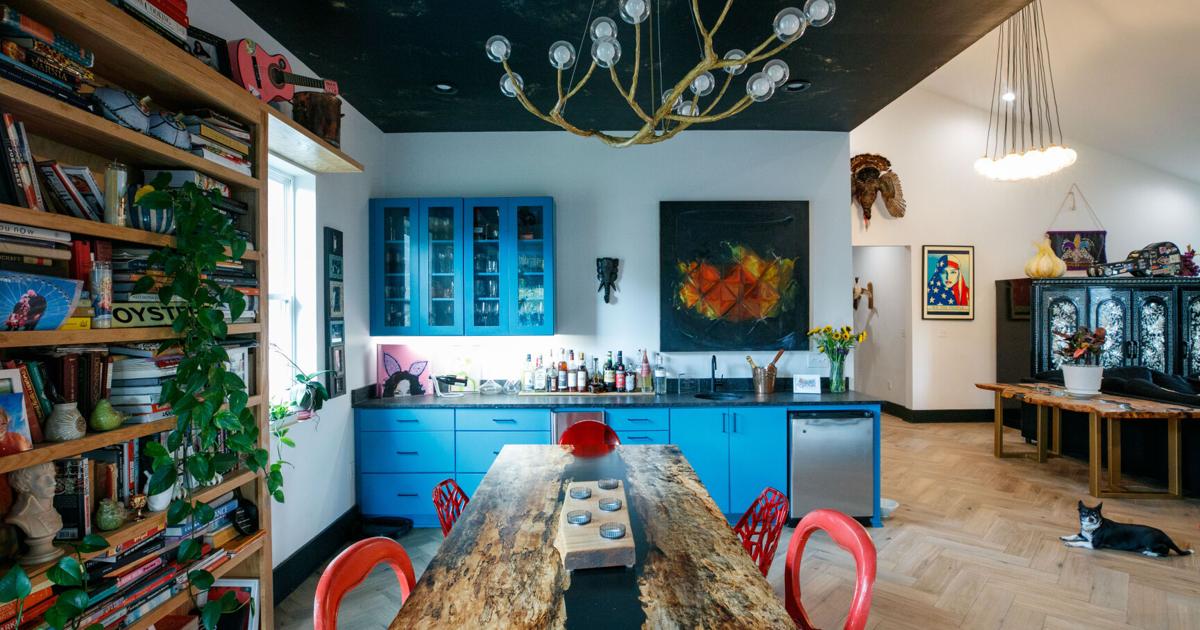
Kenny Watson Jr. executes orders for custom furniture, including increasingly elaborate dining room tables crafted from fine woods — often black walnut, mahogany or spalted maple — with resin insets and/or live edges. His client base, which also includes bars and restaurants, has grown beyond local boundaries to include clients in Mississippi, Tennessee and Baton Rouge.
The seeds for Kenny Watson Woodwork and Design were planted when Watson picked up his father’s woodworking craft during the pandemic lull in 2020, creating custom upright wooden keyboard stands for musicians. Advertising on Etsy quickly led to an abundance of orders for the sleek midcentury-modern design with legs that could easily be removed for transport and quickly reassembled. It caught on among musicians across the country.
“But I got pretty tired of making the same thing again and again,” said Watson, a Texas native who grew up in Louisiana. “So, I eventually pulled the Etsy page down.”


Watson built this dining table, inspired by midcentury modern style, from African mahogany.
That urge for change was no surprise for Watson, a Renaissance man who is the full-time bar manager at Toups Meatery in Mid-City. He also sings, plays guitar and writes music for local band Midriff, dabbles in culinary photography and is working on a pilot’s license.
After the music stands, Watson segued to designing and executing open wooden bookcases, also with a clean midcentury aesthetic, with varying sizes of built-in cubbies for storing and displaying a variety of objects. He made these primarily from his backyard on his days off. He solicited orders through Facebook Marketplace, Instagram, Craigslist and word-of-mouth.
Today, Watson works on custom orders out of Fugu Design, a co-working space in Mid-City that serves craftspeople working in woodworking and turning, ceramics, blacksmithing, welding and jewelry making.
He credits the New Orleans culinary community for the growth of his woodworking business. “The food community in New Orleans is so much more than food,” he said. “There is a lot of support for everything I do — music, woodworking, my wife and our young daughter. It’s really a big family.”

Watson built this dark walnut bar for a restaurant in Nashville.
Here’s some of what he had to say about wood furniture.
WHY SOLID WOOD?: Solid wood offers durability, a clean and timeless look and versatility. Fine wood furniture endures for generations, gaining warmth and character with age. It’s often more eco-friendly than synthetic options, especially when made from reclaimed or sustainably harvested wood. Unlike other materials, it can be repaired and refinished to extend its life.
WHY CUSTOM FURNITURE?: Custom furniture can be tailored to specific styles, lifestyles and space requirements, with options in wood type, finish and size to create a unique look. Mass-produced pieces are more affordable, quickly available and come in many designs, but may lack durability and individuality.
SOLID VS. VENEER: Solid wood is a single piece of wood, whereas veneer is a thin layer of wood glued onto a core material, such as particleboard.
SOLID
- Is it heavy? Real wood is generally heavier than veneered furniture.
- If there are drawers, are they constructed with dowels or dovetail joints? If so, it’s solid.
- No grain on any edges, only the top? It’s solid.
- The pattern, grain or color of the top matches that of the bottom? It’s solid.
- Real, solid wood that’s unfinished will always have grain that can be felt.
- Imperfection in the pattern and grain is a natural property of wood, so a piece with imperfections is likely solid.
- Desktops or dining room tabletops made from solid wood should have glue lines 10 inches apart.
- Solid wood tables have adjacent boards running in opposite directions to prevent warping.
VENEER
- Grain on the edges that goes in a different direction than the top? That’s veneer.
- Can you see a piece glued or attached to the back? That’s veneer.
- The pattern or grain runs in a completely different direction and doesn’t match the top at all? That’s veneer.
- Flawless, perfect patterns and grain? That’s a veneer.
- Antique or new? Lower-quality veneers tend to be more easily noticeable in modern furniture.
- Veneer cannot be carved.
HOW LONG WATSON’S WORK TAKES: Watson approaches his craft with care and professionalism. Depending on the project’s scope, a piece will take between one and six months to produce.
THE COST: Custom furniture typically involves greater expense and extended production timelines. Watson’s formula for determining the price for a custom piece of solid wood furniture is materials doubled plus labor. A client recently paid $9,000 for an 8-foot by 3-foot spalted maple table with resin inlays.
VISIT KENNY WATSON JR: On Instagram, @kennywatsonjr; via email, midriff.nola@gmail.com
Inside Sources is a column that tracks trends and provides consumer information from experts in their home and gardening fields.
link